
AI increasingly shapes life and business, yet the adoption of AI in ESG management remains cautious. Because AI holds pivotal potential to enhance data, processes and more in the ESG context, the key question is: How can artificial intelligence be applied effectively, efficiently, and responsibly?
Challenges in ESG management that experts face
Artificial Intelligence (AI) is increasingly shaping both our daily lives and business operations. To name a few examples: our Google search results are summarized by Gemini, Software Developers automate development using Perplexity and marketing imagery is created with Dall-E. In sustainability management, AI does not play a predominant role so far, even though a study suggests that the adoption of AI technologies enhances companies’ ESG performance.[1] Additionally, there are many potential areas of application: Environmental, Social and Governance (ESG) teams experience severe challenges during ESG data collection, report writing and ensuring regulatory compliance. Thus, using AI in ESG Management would largely benefit sustainability teams, giving them room to focus on what really matters: incorporating ESG into corporate strategies and improving the ecologic, economic and social sustainability of businesses.
ESG teams responsible for processing data for reporting and strategic management purposes face several challenges:
1. Dealing with an increasing amount of unstructured qualitative data: Increasing global ESG regulations lead to a surge in relevant KPIs, data types, and sources.[2] Traditionally, ESG data also includes a broad spectrum of qualitative information, such as diversity policies or CO2-reduction measures, often stored in non-structured formats like free text fields, Excel-tables or PDF documents. Manually collecting and analyzing unstructured data from growing data sources is challenging, time-consuming and prone to errors.[3]
2. Overcoming organizational silos: Sustainability is inherently complex and multidisciplinary, requiring integration of environmental, social, and governance perspectives into finance, operations, procurement, communication and strategy. To be effective, sustainability teams must collaborate closely with other business functions, as cross-departmental alignment is critical for achieving measurable impact.[4] Due to the multidisciplinary nature of sustainability, ESG teams must gather data from multiple departments and sources. Since mandatory ESG reporting is fairly new, many companies have not yet set up streamlined and automated data flows. ESG teams thus often search for the right contact and information within their firms and then face slow, incomplete and inconsistent data feedback, hindering their work.
3. Knowing multiple regulations: In order to be able to identify relevant data, map it to regulatory frameworks and enable compliant ESG reporting, ESG teams must know and understand all relevant frameworks (e.g. ESRS, GRI, CDP). This manual process is challenging as it is, due to the sheer width and complexity of these regulations. However, they are also undergoing constant evolvement, best illustrated by the Omnibus Initiative of the EU.[5] Trying to stay up to date is a monumental task.
4. Understanding ESG risks: Increasingly required by investors and banks, ESG risk management has become a vital part of business management.[6] Knowing ESG risks is the fundamental basis for ensuring resilient business models and securing sustainable funding. But ESG risks are often highly diverse and difficult to monetarize. Consequently, manually assessing ESG risks requires consolidating vast amounts of heterogeneous data from financial, environmental, and social domains, making the process resource-intensive and prone to inconsistency. The bigger the location and business portfolio, the more complex the analysis of risks, making the task increasingly unmanageable without advanced software or AI support. It is even more challenging, if one wants to distinguish between actual and potential risks.
5. Identifying measures: After having identified relevant KPIs like Product Carbon Footprints (PCFs) or physical climate risks, ESG teams must develop strategies and measures to mitigate identified risks and improve their company’s sustainability performance. The starting points are as numerous as the solution options, overwhelming teams with rapid innovations and constantly creating new opportunities for improvement. Finding the right levers can be challenging, given that, again, multidisciplinarity is a fact that needs to be managed in parallel.
Those are only some examples of major challenges ESG teams are facing. Comprehensive ESG management and reporting involve many more tasks that require a great deal of time and resources. All in all, it becomes apparent that ESG teams are overwhelmed by labor-intensive data collection, management and reporting tasks and are in desperate need of efficient while trustworthy solutions.
Why using AI in ESG management might be the solution to these challenges
Due to the significant workload, evaluating the most effective allocation of the capacities of ESG teams is crucial. Artificial Intelligence is a promising technology for increasing productivity levels[7] and enabling ESG team members to focus on more creative, communicative and strategic tasks like integrating sustainability governance into corporate strategies.
Many sources and industry experts recognize the application of AI in ESG management as highly impactful and transformative, as it can address one of the field’s biggest challenges: the complexity and inconsistency of ESG data. By automating data collection and processing across diverse sources—such as reports, supply chains, and regulatory disclosures, AI improves efficiency, reduces errors, and enhances comparability. Moreover, AI can detect patterns, generate insights, support more reliable risk assessments and enable good management decisions[8] helping ESG teams to move beyond resource-intensive, manual processes[9] and at the same time improve companies’ ESG performance.[1]
Areas of AI application in ESG management
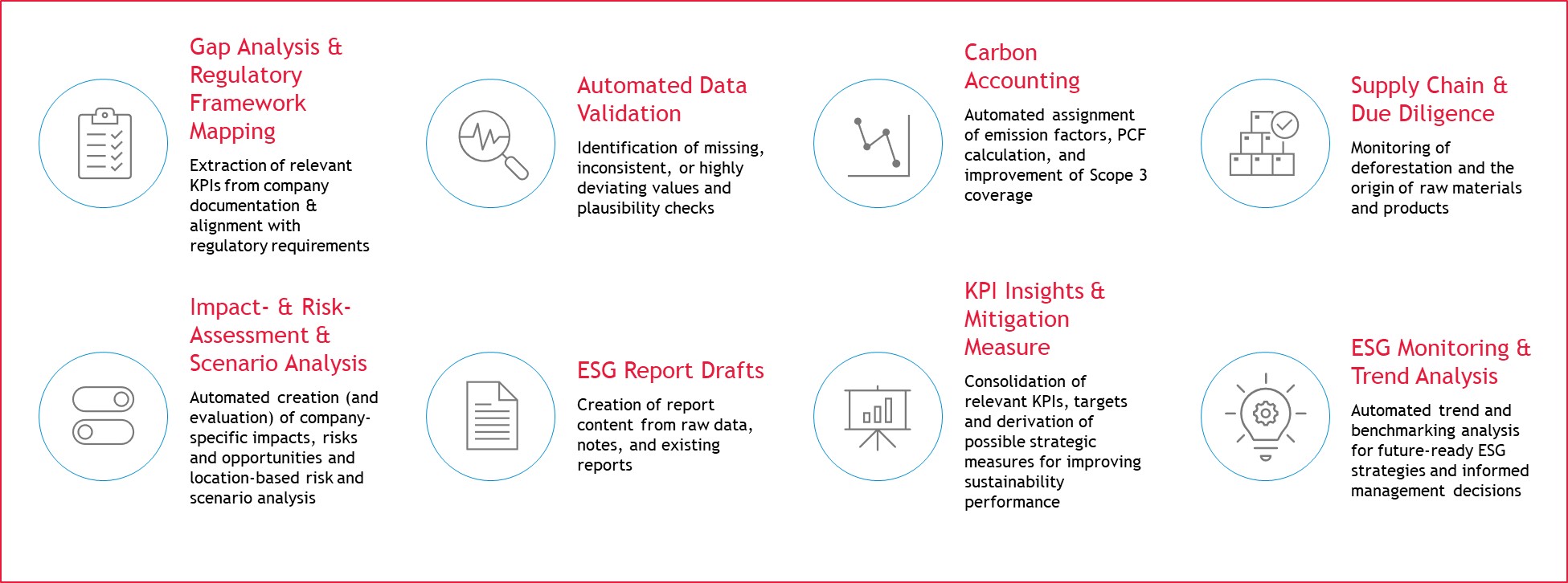
The areas of application of AI in ESG management are vast. The figure below illustrates some major areas of implementation along the journey of ESG data collection, -management and -reporting:
Depending on the area of application, AI systems can be classified as:
- Predictive AI systems that are capable of making predictions about future events by using algorithms that generate forecasts based on historical data. As such they are perfect for example for energy demand forecasting, climate risk modelling[6] and carbon footprint estimation.
- Prescriptive AI systems make proposals for courses of action to achieve a certain outcome. Algorithms run through different scenarios to find the best course of action. Prescriptive AI systems can therefore potentially help to identify ESG-compliant investment strategies, supply chain optimization opportunities or measures to lower climate risks.[6]
- Generative AI systems are able to create own content in the form of written text, audio, images or videos based on specifications. They do not only learn from data but also generate new data instances that mimic the characteristics of the input data. While ChatGPT is a prominent example of generative AI, generative AI in ESG management may automate ESG reporting by generating first drafts from raw data, or aligning ESG data with disclosure requirements like ESRS, GRI or SASB.[10]
AI is the key to sustainable development
Artificial intelligence is already redefining the landscape of ESG management and will continue to do so. Given the complexity of ESG data, the need for regulatory compliance, and the inherent risks of AI use such as bias, data protection concerns, and lack of transparency, the hesitation to exploit the potential artificial intelligence holds, is understandable. Still, artificial intelligence is highly recognized for its promise to address exactly the challenges that ESG teams struggle with most: fragmented and unstructured data, growing regulatory demands, and resource-intensive risk assessments. By automating data collection, structuring heterogeneous information, and supporting predictive and prescriptive analysis, AI can make ESG reporting more accurate, comparable, and efficient while freeing teams to focus on strategy and impact. At the same time, responsible governance is essential: AI in ESG management must be explainable, auditable, and compliant with evolving regulations like the EU AI Act and CSRD. Used effectively and responsibly, AI will not replace human judgment in sustainability management — but it can serve as a powerful tool to overcome today’s knowledge bottlenecks and unlock ESG’s transformative role in shaping sustainable, future-proof and resilient businesses.