Google’s dominance in traditional search is softening, while answer engines and generative AI platforms are changing how users discover information. For marketers, the practical response is no longer search engine optimization (SEO) alone, but a three-part visibility strategy: SEO for discoverability, answer engine optimization (AEO) for direct answers, and generative engine optimization (GEO) for inclusion in AI-generated responses.
SEO Still Matters – But It No Longer Stands Alone
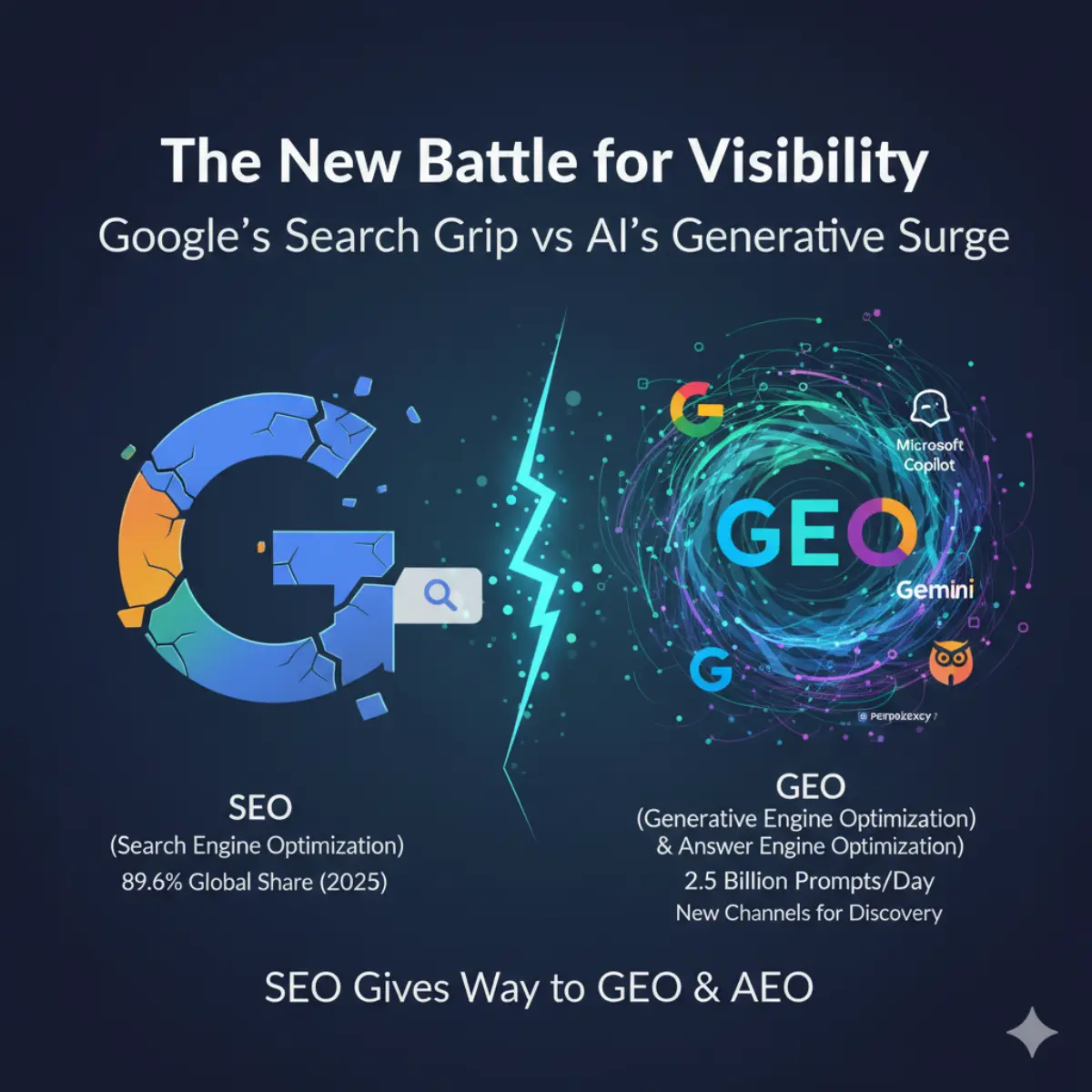
Google is not collapsing, but its once near-unshakeable share of search is showing measurable signs of softening. In a surprising shift, Google’s global search engine market share slipped below 90% for the first time in nearly a decade – hitting approximately 89.6% in late 2024 and early 2025.[1] Meanwhile, in the U.S., Google’s share fell to around 86 – 87%, with Bing capturing roughly 7 – 8%.[2]
At the same time, generative AI platforms like ChatGPT, Microsoft Copilot, Perplexity, Claude and Google Gemini are absorbing increasing volumes of query-style traffic, accelerating interest in GEO (Generative Engine Optimization) and AEO (Answer Engine Optimization). For CMOs and marketing leaders, the implication is clear: traditional search engine optimization (SEO) remains essential, but it is no longer sufficient on its own.
Google Is Still Dominant – But the First Real Cracks Are Showing
The right interpretation is not that Google has fallen, but that marketers can no longer assume a single-channel search strategy is future-proof. Google remains the undisputed leader, but the emergence of cracks is undeniable. As of March – April 2025, Google’s global search share hovered around 89.6%, dipping below 90% consistently for the first time since the mid-2010s.[3] In the U.S., the share fell to 86 – 87%, while Bing’s foothold rose modestly to 7 – 8%.[1]
Daily usage data further underscores the scale: generative AI platforms process over 2.5 billion prompts per day, whereas Google handles roughly 14 billion searches daily.[4] While Google’s dominance is still vast, these numbers signal the rise of powerful new channels for discovery and attention.
Which Generative Engines Are Reshaping Discovery?
Generative engines are not replacing search at the same scale, but they are changing how users ask questions and how brands earn visibility. Generative AI platforms are disrupting the query ecosystem. Generative search is not just a fringe trend – it is commanding real user attention. As of May – June 2025, ChatGPT held around 59.5 – 60.6% of the generative AI chatbot market, with Microsoft Copilot at approximately 14.3%, Google Gemini at approximately 13.4%, Perplexity at approximately 6%, and Claude AI at approximately 3.1 – 3.2%.[5] These numbers mark a reshaping of the query landscape, especially for users seeking conversational or summarization-style answers.
Still, referral patterns from AI platforms tell a different story. According to Statcounter AI data, ChatGPT sends nearly 79.8% of all chatbot-generated referral traffic to websites, while Perplexity contributes 11.8%, and Copilot only 5.2%, with Google Gemini at a surprisingly low approximately 2%.[6]
Meanwhile, generative AI platforms collectively handle over 2.5 billion prompts daily, compared to approximately 14 billion traditional search queries processed by Google each day.[7] This contrast highlights why volume still favors traditional search, but the value propositions are drifting.
In short, AI platforms are redefining how users frame questions and consume answers. That behavioral shift is why Answer Engine Optimization (AEO) and Generative Engine Optimization (GEO) are becoming practical disciplines rather than speculative buzzwords.
| Acronym | Stands For | Goal |
| AEO | Answer Engine Optimization | Earn visibility in direct-answer surfaces such as snippets, AI Overviews, and knowledge panels |
| GEO | Generative Engine Optimization | Increase the likelihood that AI systems reference, summarize, or cite your content |
Why Aren’t AI Queries Disrupting Website Traffic Yet?
Because prompt volume and referral value are not the same thing. While platforms like ChatGPT may process billions of prompts, the impact on web traffic remains muted.
- Scale still favors search: ChatGPT may handle around 2.5 billion prompts per day, but Google still processes roughly 14 billion searches – an enormous gap that continues to favor traditional search behavior.
- Referral traffic remains scarce: AI-generated answers often send little traffic back to publishers, frequently at rates below 1%, while Google still drives the overwhelming majority of measurable inbound visits.
- Traditional search still dominates: Even with rapid AI adoption, generative platforms remain a minority share of total search-style behavior, leaving Google’s ecosystem firmly in control for now.
The key takeaway is that query behavior is shifting faster than traffic behavior. SEO remains the most dependable source of measurable visits today, while AEO and GEO are better understood as strategic growth layers with emerging – but still uneven – ROI.
GEO vs. AEO: What’s the Difference?
AEO is about winning direct answers; GEO is about becoming part of AI-generated answers. The two overlap, but they are not interchangeable.
| Feature | GEO (Generative Engine Optimization) | AEO (Answer Engine Optimization) |
| Definition | Optimizing content for generative AI engines | Optimizing content for answer engines |
| Main Focus | Visibility in AI-generated responses | Visibility in direct answers to questions (e.g. snippets) |
| Target Platforms | ChatGPT, Claude, Gemini, Perplexity, etc. | Google (featured snippets, knowledge panels), Bing, etc. |
| Optimization Strategy | Structured, factual, conversational, context-rich content | Concise, authoritative answers with schema & structured data |
| Goal | Be referenced or included in AI outputs | Be selected as the direct answer to a query |
| Approach | Focus on semantic relevance and source credibility | Focus on content clarity, schema markup, and authority |
| Content Type | Long-form, well-cited, trustworthy sources | Q&A, FAQs, definitions, how-to |
| Tools used | AI prompt analysis, LLM-aware SEO, backlinks, structured content | Schema.org, structured data, Google Search Console |
What Should Marketers Do Now?
Marketers should not abandon SEO; they should expand it into a multi-surface visibility strategy. The slow erosion of Google’s traffic dominance is not yet a crisis, but it is a signal. Traditional SEO strategies remain powerful, yet emerging paradigms – AEO and GEO – present new risks and opportunities.
- Hidden risk: Zero-click behavior is accelerating. Google’s AI Overviews can absorb attention before users ever reach a publisher’s page, reducing click-through rates even when a site still ranks highly.[8]
- Under-investment in GEO: AI referrals are growing quickly from a small base. That makes GEO strategically important, even if it still represents only a tiny share of total publisher traffic today.
3-Step Optimization Framework
This inflection point is not about abandoning search; it is about diversification. Marketing leaders should move from a mono-channel mindset to a tripartite optimization framework:
- Continue investing heavily in SEO to preserve discoverability, rankings, and inbound traffic.
- Build AEO capabilities through structured content, answer-first formatting, schema, and definition-style sections that can win direct-answer placements without sacrificing brand control.
- Allocate resources to GEO by creating conversational, well-cited, entity-rich content designed to be reused, summarized, and referenced by generative AI systems.
For conversion-focused CMOs and SEO agencies, success will depend on balancing scale, engagement, and evolving discovery behavior. The winning strategy is hybrid visibility across traditional search, answer-driven interfaces, and generative AI conversations.
What Comes After Keywords in a Post-SERP (Search Engine Results Page) World?
The next visibility battle is less about blue links alone and more about whether your content becomes the answer layer itself. As generative AI becomes a preferred channel for question answering, the mechanics of search visibility are shifting – from ranking to relevance in context-aware models. Instead of driving users to links, platforms like ChatGPT deliver synthesized responses within the interface. This changes the game for content marketers: your narrative must be understandable, quotable, and reusable inside the AI output – not only attractive on the search results page.
In this future, structured data, semantic clarity, and brand presence inside AI engines are your new ranking factors. The traditional SERP (search engine results page) will remain important, but it is no longer the only battleground.
Where We Stand in 2026
The strategic lesson for 2026 is clear: brands should treat 2025’s search signals as a warning to diversify visibility now, before user behavior shifts even further. The future of search is fractured – and that is a strategic opportunity.
- Google still dominates traditional search, so SEO remains essential.
- Generative platforms such as ChatGPT, Copilot, and Gemini capture billions of prompts, but still drive limited referral traffic – making GEO strategically important, but still early.
- AEO is growing quickly, especially through direct-answer formats and Google AI Overviews.
- For CMOs and SEO agencies, hybrid visibility strategies across SEO, AEO, and GEO are now the most resilient path forward.