SEO Gives Way to GEO & AEO
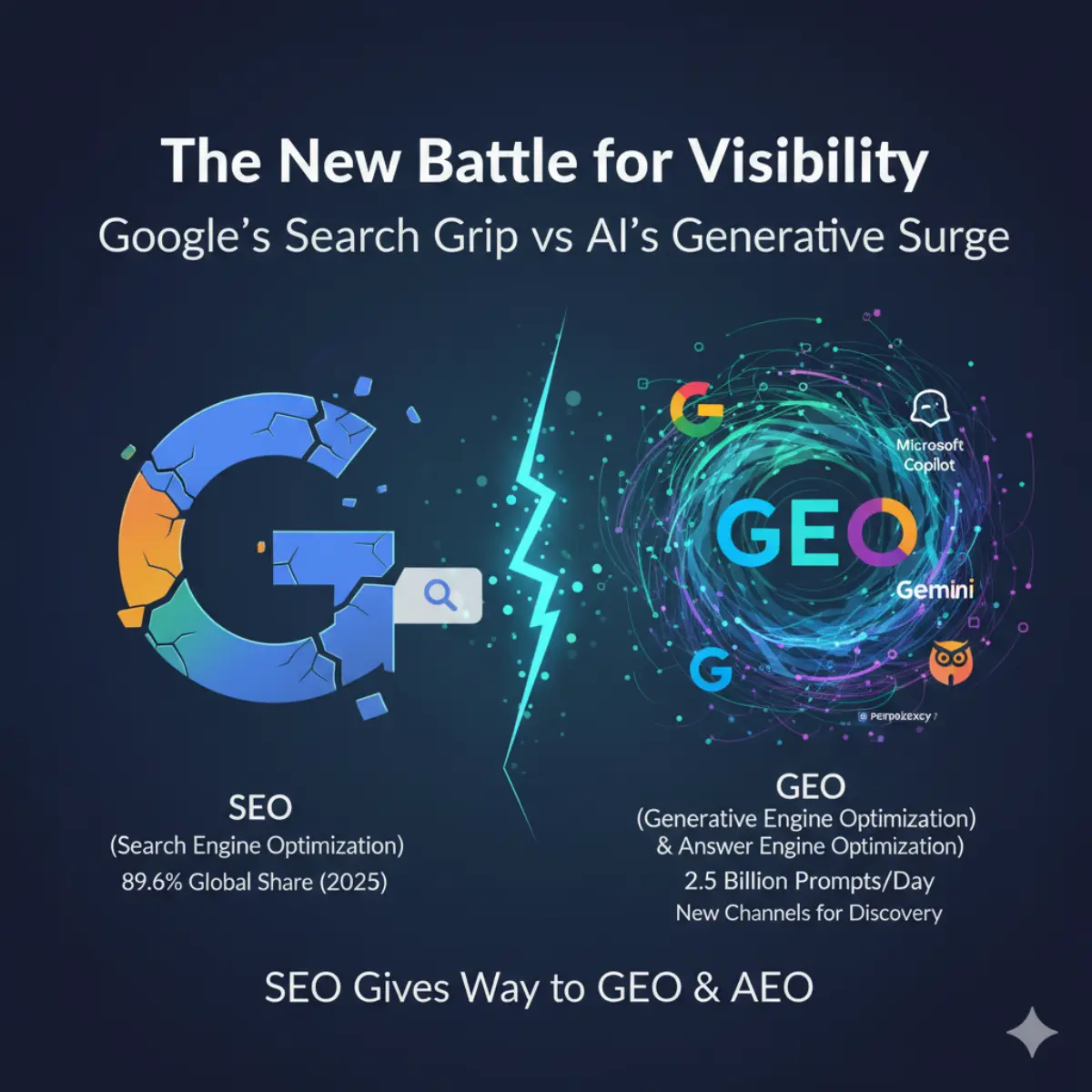
What if the world’s most dominant tech company quietly starts losing its grip? In a surprising shift, Google’s global search engine market share slipped below 90% for the first time in nearly a decade—hitting approximately 89.6% in late 2024 and early 2025.[1] Meanwhile, in the U.S., Google’s share fell to around 86–87%, with Bing capturing roughly 7–8%.[2]
At the same time, generative AI platforms like ChatGPT, Microsoft Copilot, Perplexity, and Google Gemini are absorbing increasing volumes of query-style traffic—pioneering new fields: GEO (Generative Engine Optimization) and AEO (Answer Engine Optimization). For CMOs and heads of marketing, this means traditional search engine optimization (SEO) alone won’t cut it in the evolving search landscape.
A 30-Year Giant Stumbles—But Does Not Fall
Google remains the undisputed leader—but the emergence of cracks is undeniable. As of March–April 2025, Google’s global search share hovered around 89.6%, dipping below 90% consistently for the first time since the mid‑2010s.[3] In the U.S., the share fell to 86–87%, while Bing’s foothold rose modestly to 7–8%.[1]
Daily usage data further underscores the scale: generative AI platforms process over 2.5 billion prompts per day, whereas Google handles roughly 14 billion searches daily.[4] While Google’s dominance is still vast, these numbers signal the rise of powerful new channels for discovery and attention.
The Rise of Generative Engines: ChatGPT, Copilot, Gemini & Co.
Generative AI platforms are disrupting the query ecosystem. Generative search isn’t just a fringe trend—it’s commanding real user attention. As of May–June 2025, ChatGPT held around 59.5–60.6% of the generative AI chatbot market, with Microsoft Copilot at ~14.3%, Google Gemini at ~13.4%, Perplexity at ~6%, and Claude AI at ~3.1–3.2%.[5] These numbers mark a reshaping of the query landscape—especially for users seeking conversational or summarization-style answers.
Still, referral patterns from AI platforms tell a different story. According to Statcounter AI data, ChatGPT sends nearly 79.8% of all chatbot-generated referral traffic to websites, while Perplexity contributes 11.8%, and Copilot only 5.2%, with Google Gemini at a surprisingly low ~2%.[6]
Meanwhile, generative AI platforms collectively handle over 2.5 billion prompts daily, compared to approximately 14 billion traditional search queries processed by Google each day.[7] This contrast highlights why volume still favors traditional search—but the value propositions are drifting.
In short: AI platforms are redefining how users frame questions and consume answers. This evolving behavior gives rise to Answer Engine Optimization (AEO) and Generative Engine Optimization (GEO) as critical disciplines marketers must now master.
| Acronym | Stands For | Goal |
| AEO | Answer Engine Optimization | Rank in traditional answer engines |
| GEO | Generative Engine Optimization | Be used by AI tools like ChatGPT |
Volume vs. Value: Why AI Queries Aren’t Disrupting Traffic—Yet
While platforms like ChatGPT may process billions of prompts, the impact on web traffic remains muted.
- Scale vs. impact: ChatGPT handles around 2.5 billion prompts daily, compared to Google’s roughly 14 billion search queries—a stark volume disparity that still tilts heavily toward traditional search.
- Referral traffic is scarce: AI-generated answers refer users to publisher websites at extremely low rates—often less than 1%. By contrast, Google continues to drive the vast majority of inbound visits.
- Search dominance endures: Despite rapid growth in generative AI adoption, its share of total search-style queries remains under 5–10%, leaving Google’s ecosystem firmly in control.
The key takeaway: shifting query behavior isn’t yet shifting traffic patterns. For now, SEO remains the most consistent driver of measurable web traffic—while AEO and GEO promise future potential, they deliver experimental ROI at present.
GEO vs AEO — What’s the Difference?
| Feature | GEO (Generative Engine Optimization) | AEO (Answer Engine Optimization) |
| Definition | Optimizing content for generative AI engines | Optimizing content for answer engines |
| Main Focus | Visibility in AI-generated responses | Visibility in direct answers to questions (e.g. snippets) |
| Target Platforms | ChatGPT, Claude, Gemini, Perplexity, etc. | Google (featured snippets, knowledge panels), Bing, etc. |
| Optimization Strategy | Structured, factual, conversational, context-rich content | Concise, authoritative answers with schema & structured data |
| Goal | Be referenced or included in AI outputs | Be selected as the direct answer to a query |
| Approach | Focus on semantic relevance and source credibility | Focus on content clarity, schema markup, and authority |
| Content Type | Long-form, well-cited, trustworthy sources | Q&A, FAQs, definitions, how-to |
| Tools used | AI prompt analysis, LLM-aware SEO, backlinks, structured content | Schema.org, structured data, Google Search Console |
A Strategic Inflection Point for Marketers
The slow erosion of Google’s traffic dominance isn’t yet a crisis—but it’s a signal. Traditional SEO strategies remain powerful, yet emerging paradigms—AEO and GEO—present new risks and opportunities.
- Hidden risks: Zero-click searches fueled by Google’s AI Overviews now account for up to 69% of news-related queries, up from 56% a year ago. Sites that once held top rankings have seen click-through rates plummet by nearly 80% when an AI Overview appears above them.[8]
- Under-investment in GEO: While ChatGPT’s referral traffic to publishers grew eightfold—from ~435,000 visits in August to ~3.5 million in January—it still represents less than 0.1% of overall traffic across top media sites.
This inflection isn’t about abandonment—it’s about diversification. Marketing leaders need to shift from a mono-channel mindset to a tripartite optimization framework:
1. Heavy investment in search engine optimization to retain discoverability and inbound traffic
2. Develop answer engine optimization tactics—structured content that earns AI-overview placements without sacrificing brand control
3. Allocate resources to generative AI optimization —creating conversational-first content and prompts tailored for generative AI platforms
For conversion-focused CMOs and SEO agencies, success will depend on balancing scale, engagement, and emerging behavioral patterns. The future belongs to hybrid strategies that command visibility across search types—long-tail Google, answer-driven overviews, and generative AI dialogues.
What Comes After Keywords? Preparing for the Post-SERP (Search Engine Result Page) World
As generative AI becomes a preferred channel for question answering, the mechanics of search visibility are shifting—from ranking to relevance in context-aware models. Instead of driving users to links, platforms like ChatGPT deliver synthesized responses within the interface. This changes the game for content marketers: your narrative must live within the AI output, not just your page title.
In this future, structured data, semantic clarity, and brand presence inside AI engines are your new ranking factors. The traditional SERP may survive—but it’s no longer the only battleground.
Where We Stand in 2025
The future of search is fractured—and that’s a strategic opportunity.
- Google still dominates with ~89–90% of global traditional search—SEO remains essential
- Generative platforms like ChatGPT, Copilot, and Gemini capture billions of prompts, but drive minimal referral traffic—GEO is emerging
- Answer Engine Optimization (AEO) is growing fast, especially through Google AI Overviews
- For CMOs and SEO agencies, hybrid visibility strategies across SEO, AEO, and GEO are the only path forward